Over the years as a WordPress developer, I’ve built dozens of sites from scratch. Many clients start by asking about pre-made themes because they look polished and cost less upfront. But after launching and maintaining those sites for months, they often come back wanting something custom.
If you’re running or planning a WordPress website, choosing between a pre-made theme and a custom one can make or break your long-term success. In this post, I’ll share what I’ve learned from real projects — the actual benefits, trade-offs, and when it makes sense to invest in custom development.
What Exactly Is a Custom WordPress Theme?
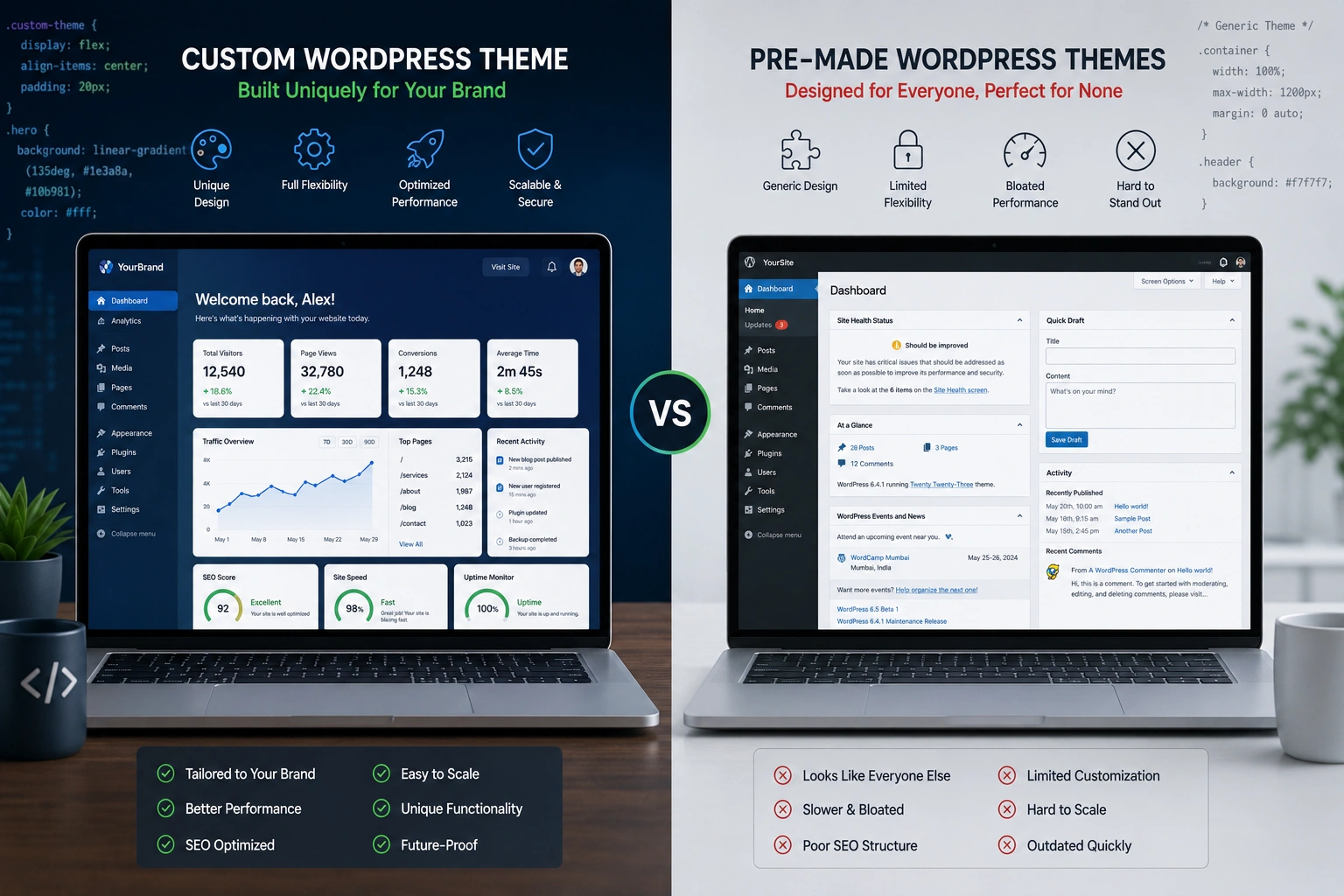
A custom WordPress theme is built from the ground up (or heavily modified from a starter framework) to match your exact brand, functionality needs, and performance goals. Unlike pre-made themes that come with hundreds of options and demo content, a custom solution is tailored code written specifically for you.
I usually start with a clean slate using tools like Underscores or Sage, then layer in only what the project requires. This approach gives complete control over every pixel and every database query.
Performance and Speed Advantages
Pre-made themes often pack every possible feature — sliders, page builders, animations, and shortcodes — whether you need them or not. This bloat slows down your site.
In my experience, switching clients from popular marketplace themes to custom builds consistently improved loading times by 40-60%. One e-commerce client saw their Google PageSpeed score jump from 62 to 94 after we stripped unnecessary code.
A lean custom WordPress theme loads only the CSS and JavaScript your site actually uses. This matters for SEO, user experience, and conversion rates. WordPress.org itself emphasizes clean, efficient code as a best practice for sustainable sites.
Design Freedom and Brand Consistency
Pre-made themes force you to work within someone else’s design system. You can tweak colors and fonts, but you’re still operating inside predefined layouts and component styles.
With a custom theme, your WordPress website looks and feels exactly like your brand. No more fighting with template overrides or wondering why your homepage doesn’t match your marketing materials.
I recently worked with a coaching client whose pre-made theme made their site look like every other coach online. After a custom redesign, their brand stood out immediately. Bounce rate dropped and time on page increased noticeably.
Long-Term Maintenance and Scalability
This is where many people underestimate the cost of pre-made themes.
Pre-made themes get frequent updates from their authors — sometimes breaking customizations you’ve made. You’re also dependent on third-party plugin compatibility that can break with WordPress core updates.
A well-built custom theme, on the other hand, is easier to maintain because I control the architecture. When new features are needed, we extend the existing code instead of layering workarounds.
Business Impact and ROI of Custom Development
For serious businesses, the investment in a WordPress developer who builds a custom theme almost always pays off.
- Better SEO performance from clean code and proper schema
- Higher conversion rates through tailored user journeys
- Easier future updates and feature additions
- Stronger security posture (fewer known vulnerabilities from popular themes)
One client running an online course platform initially used a premium multi-purpose theme. After six months of slow performance and constant plugin conflicts, we rebuilt it custom. Their site now handles twice the traffic with half the server resources.
How to Decide: Custom vs Pre-Made Theme
Here’s a quick comparison based on projects I’ve handled:
| Factor | Pre-Made Theme | Custom Theme |
| Initial Cost | Low | Higher |
| Launch Time | Fast | 4-8 weeks typically |
| Performance | Often average | Excellent |
| Uniqueness | Limited | Fully unique |
| Long-term Cost | Can add up | Lower maintenance |
| Scalability | Moderate | High |
If you’re a small blog or testing an idea, a good pre-made theme might suffice. For anything representing your main business, custom usually wins.
Step-by-Step Process for Building a Custom WordPress Theme
Here’s how I approach custom theme development with clients:
- Discovery & Planning — We map out required features, user flows, and design requirements. I avoid assuming anything.
- Design Phase — Create custom wireframes and high-fidelity mockups tailored to your brand.
- Development — Build the theme using modern standards (block editor compatible, accessible, performant).
- Content Integration — Import and optimize existing content.
- Testing & Optimization — Speed tests, mobile responsiveness, security audit.
- Training & Handover — Show you how to manage content without breaking the design.
This structured approach prevents scope creep and delivers predictable results.
Common Mistakes to Avoid with WordPress Themes
I’ve seen these issues repeatedly:
- Choosing a theme based only on how it looks in demos instead of required functionality.
- Over-customizing a pre-made theme until it becomes a maintenance nightmare.
- Ignoring mobile performance during selection.
- Not planning for future growth (e.g., adding membership features later).
Another big one: buying multiple page builders thinking they’ll solve everything. They usually create more problems than they solve.
If you’re already stuck with a heavy pre-made theme, we can often salvage and optimize it rather than starting completely from scratch. Feel free to reach out.
Frequently Asked Questions
How much does a custom WordPress theme cost?
Prices vary widely depending on complexity. Simple custom themes start around professional development rates, while complex sites with custom functionality cost more. The key is focusing on ROI rather than just upfront price.
Can I convert my existing pre-made theme to custom?
Often yes. We can extract your content and design direction, then build a cleaner, faster foundation.
Will a custom theme work with the Block Editor?
Absolutely. Modern custom themes are built to fully support Gutenberg and future WordPress updates.
How long does custom theme development take?
Typically 4-10 weeks depending on scope. This includes design, development, and revisions.
Is a custom theme better for SEO?
Yes, generally. Clean code, proper heading structure, faster load times, and custom schema markup give custom sites an edge.
Ready to Build a WordPress Website That Actually Works for Your Business?
A custom WordPress theme gives you performance, uniqueness, and control that pre-made options simply can’t match. While they require more investment upfront, they save time, money, and frustration in the long run.
If you’re tired of fighting with template limitations or dealing with slow loading times, let’s talk. Visit my personal site or check out our services at Digital Wind IT to see how we can create a WordPress website built specifically for your goals.